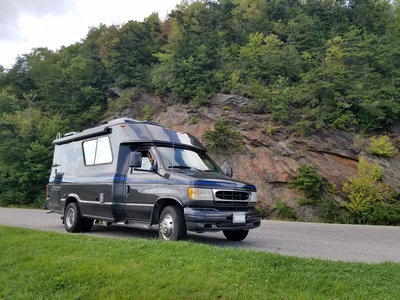
2013 Door Panels on 04 Chinook Concourse
2013 Door Panels on 04 Chinook Concourse
.
Last edited by dougm on November 22nd, 2020, 12:35 pm, edited 1 time in total.
Re: 2013 Door Panels on 04 Chinook Concourse
Very nice score and upgrade......as silly as it sounds I do miss my windows auto roll down when in Chinook.
2001 Concourse XL Lounge model, 6.8L Ford E350 Triton V-10 Chassis.
Re: 2013 Door Panels on 04 Chinook Concourse
Brief video i made to show that these panels can be made to function properly in an earlier model van or Chinook if you know how to convert them. 
https://youtu.be/4hfKqa74R_4
https://youtu.be/4hfKqa74R_4
Re: 2013 Door Panels on 04 Chinook Concourse
Since i found that this information cant be found on any forum and has apparently taken some 13 years for someone to figure out  . I thought i would share the answer to this apparent late model door panel swap dilema with my fellow Chinook owners in case they get the urge to swap door panels. Keep in mind this applies to the ford based vehicles such as the E-350.
If you open one of your door lock switches and inspect them, you will see that they are nothing more than a manual 12 volt relay. In order to swap door panels you have to remove those old switches (relays). The problem arises in that you are now installing a switch that is not designed to carry 12 volt positive loads, where as your old switches are. The new switches are designed to send a ground signal, not transfer voltage from a source to a load.
Your new door lock switches are nothing more than a momentary on-off switch. Where as your old door lock switches are actually manual relays.
With that said you have to replace the old switches (relays) with something that will transfer 12 volts from a source to a load (door actuator) using a ground signal. Since the old switch is nothing more than a manual relay, we can simply replace them with electric relays, keeping in mind the door locks utilize reverse polarity to lock and unlock the door locks (actuators).
The new door lock switches are only capable of sending a ground signal when the button is pressed. They have 4 wires, one wire is hot always when the key is on, that wire illuminates the LED's inside the switch. The other three wires are ground wires, one wire is a constant ground and the other two are switched grounds that send a ground signal to the relay when the button is pressed. If you try to send voltage threw the new switches you will fry them because they arent designed to carry voltage/amperage.
You have to manufacture a relay system for each door that uses a negative (ground) signal to activate the relays, in turn sending 12 volts from a source to the load (door lock actuators).
The actuators have two wires, for this example we will call our wires purple and green, but we cant confuse them as being positive and negative because the system uses reverse polarity. Meaning In order to lock the door for example... 12 volts is sent threw the purple wire while green acts as ground, in order to unlock the door 12 volts is then sent threw the green wire while the purple acts as ground. This switching is accomplished inside the relays.
Keep in mind that each door has its own actuator, that means each door must have its own relay system. It is the relays job to insure that a wire isnt grounded when a 12 volt signal is sent to that wire, and of course the person responsible for wiring the system in the first place.
Here is a good example of a door lock relay system activated by a ground signal. Since the actuators utilize reverse polarity the system requires two relays per actuator to accomplish the reverse polarity effect.
Your new window switches will function properly by simply cutting the wires and splicing them correctly while referencing the correct wiring diagrams for each vehicle involved.
. I thought i would share the answer to this apparent late model door panel swap dilema with my fellow Chinook owners in case they get the urge to swap door panels. Keep in mind this applies to the ford based vehicles such as the E-350.If you open one of your door lock switches and inspect them, you will see that they are nothing more than a manual 12 volt relay. In order to swap door panels you have to remove those old switches (relays). The problem arises in that you are now installing a switch that is not designed to carry 12 volt positive loads, where as your old switches are. The new switches are designed to send a ground signal, not transfer voltage from a source to a load.
Your new door lock switches are nothing more than a momentary on-off switch. Where as your old door lock switches are actually manual relays.
With that said you have to replace the old switches (relays) with something that will transfer 12 volts from a source to a load (door actuator) using a ground signal. Since the old switch is nothing more than a manual relay, we can simply replace them with electric relays, keeping in mind the door locks utilize reverse polarity to lock and unlock the door locks (actuators).
The new door lock switches are only capable of sending a ground signal when the button is pressed. They have 4 wires, one wire is hot always when the key is on, that wire illuminates the LED's inside the switch. The other three wires are ground wires, one wire is a constant ground and the other two are switched grounds that send a ground signal to the relay when the button is pressed. If you try to send voltage threw the new switches you will fry them because they arent designed to carry voltage/amperage.
You have to manufacture a relay system for each door that uses a negative (ground) signal to activate the relays, in turn sending 12 volts from a source to the load (door lock actuators).
The actuators have two wires, for this example we will call our wires purple and green, but we cant confuse them as being positive and negative because the system uses reverse polarity. Meaning In order to lock the door for example... 12 volts is sent threw the purple wire while green acts as ground, in order to unlock the door 12 volts is then sent threw the green wire while the purple acts as ground. This switching is accomplished inside the relays.
Keep in mind that each door has its own actuator, that means each door must have its own relay system. It is the relays job to insure that a wire isnt grounded when a 12 volt signal is sent to that wire, and of course the person responsible for wiring the system in the first place.
Here is a good example of a door lock relay system activated by a ground signal. Since the actuators utilize reverse polarity the system requires two relays per actuator to accomplish the reverse polarity effect.
Your new window switches will function properly by simply cutting the wires and splicing them correctly while referencing the correct wiring diagrams for each vehicle involved.
Re: 2013 Door Panels on 04 Chinook Concourse
I spend hours fixing the door lock switch the other days. If I knew about this, I might consider getting the newer door panel because I like the lighted switches. However, there are these wood-grain frames around the switches for the Chinook, so if I do end up with a good deal on the new door panels, I kind of hate to get rid of the wood frames.
At any rate, it is very good info to know about this alternative. I may take this up if the switches failed again. If you can draw up a diagram about the wiring, it will be very useful for those of us how are more graphically less challenged, if you know what I mean.
At any rate, it is very good info to know about this alternative. I may take this up if the switches failed again. If you can draw up a diagram about the wiring, it will be very useful for those of us how are more graphically less challenged, if you know what I mean.
2000 Concourse dinette, on 1999 6.8L Ford E350 Triton V-10 Chassis
Re: 2013 Door Panels on 04 Chinook Concourse
.
Last edited by dougm on November 22nd, 2020, 12:35 pm, edited 1 time in total.
Re: 2013 Door Panels on 04 Chinook Concourse
.
Last edited by dougm on November 22nd, 2020, 12:36 pm, edited 1 time in total.
Re: 2013 Door Panels on 04 Chinook Concourse
I am confused about what you meant by manual relay. A relay, in my experience, is a device that have a coil that can be energized, and there are two or more other connections that will have different connectivity depends on whether the coil is energized or not. If there is no coil, then it is just a regular switch, no? Do you have the Ford part number so maybe I can do a search.
When I was trying to fix my door switches, I took the switch apart to clean the contacts, and they are just regular, automative-grade switch. Mine is a 2000 E350. The switches I looked at were for the windows and the power lock.
I understand the difference in polarity and rather the switch is for switching the driving current directly, vs. switching the lower current control signal. I just curious about the details. Very appreciate the info you provided here.
When I was trying to fix my door switches, I took the switch apart to clean the contacts, and they are just regular, automative-grade switch. Mine is a 2000 E350. The switches I looked at were for the windows and the power lock.
I understand the difference in polarity and rather the switch is for switching the driving current directly, vs. switching the lower current control signal. I just curious about the details. Very appreciate the info you provided here.
2000 Concourse dinette, on 1999 6.8L Ford E350 Triton V-10 Chassis
Re: 2013 Door Panels on 04 Chinook Concourse
.
Last edited by dougm on November 22nd, 2020, 12:36 pm, edited 6 times in total.
Re: 2013 Door Panels on 04 Chinook Concourse
Thank you Doug. I were confused, but I think after you explained it and it is clear to me now. The switch is actually pretty specialized. They could have save a lot of money if they use regular commodity switch, but it will not look as good.
2000 Concourse dinette, on 1999 6.8L Ford E350 Triton V-10 Chassis