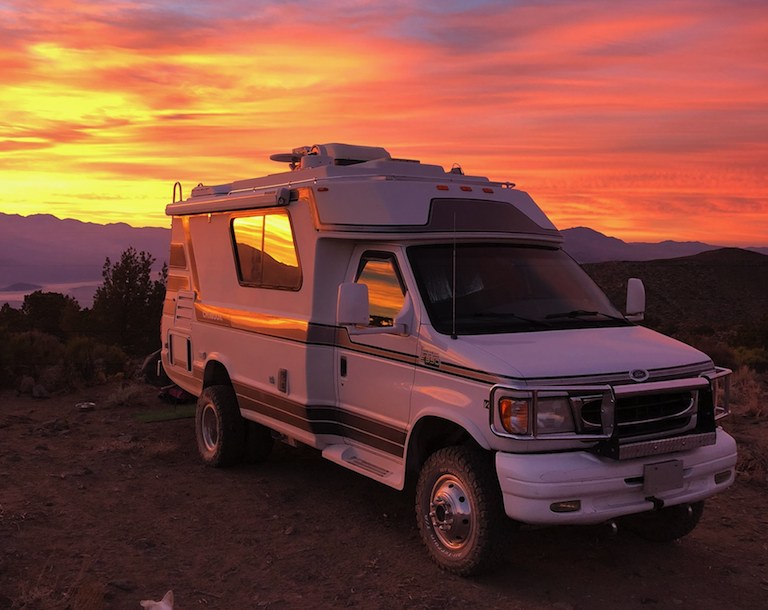
Camping at 30 degrees and Can't Get Warm
Re: A Note on Cold Camping
I found a lot of air was coming in the slotted grate behind the 3 burner stovetop. Is that a known issue in cold windy weather? And I closed the the 4 dash vent intakes. Seemed to be a little cozier with those adjustments.

Re: A Note on Cold Camping
I'm not sure what you mean by this grate? I think the older Chinooks (than mine) sometimes had a "real" range hood that lead to the outdoors, vs. the one like mine that just recirculated -- and those can leak for sure, but then you didn't say range hood.Roger D wrote:I found a lot of air was coming in the slotted grate behind the 3 burner stovetop. Is that a known issue in cold windy weather?
Oh wait, looking at photos of my original oven, there are slots at the back on the metal top, and they lead into the cavity behind the stove. Now that "shouldn't" lead anywhere but into the sealed void behind the stove, but I can think of a couple of ways that cold air could get into that space.
1) There are three holes in the floor in that hidden section (it's behind a false wall outboard of the oven). Two are for propane lines coming in to the stove and fridge, and one is for the fridge drain line. That said, mine were very well sealed with those little plastic through hull cuff thingies they used, plus silicone.
2) One propane line and the drain line lead over into the refrigerator outdoor service compartment. Again, these should be well sealed, but if not, there could be air coming from the refrigerator intake area (this would NOT be good as that combustion chamber area behind the fridge should be completely sealed from the living space).
Or it could just be the cold/unheated air in that false compartment being sucked into the rig via pressure differential. Not sure how you would really solve that, because that air space is there to help cool the back of the oven so it's not like you'd want to block it off. I'd say that's the most likely cause.
Anyway, a few things to look at.
Closing the dash vents helps (for mice as well), but a cab curtain would make a huge difference. The cab is very poorly insulated and filled with heat robbing glass.
1999 Concourse
Re: Camping at 30 degrees and Can't Get Warm
Yes it's the slots at the back of the stove top. A lot of air entering there. It was a breeze. I don't have an oven. Just a storage cabinet under the 3 burner stovetop. I thot the slots might be a makeup air source for the hood. That would need an outside air source to be effective. Guess I'll dig into those areas when I get back. Thanks
Re: Camping at 30 degrees and Can't Get Warm
Oops, shouldn't have assumed you have an oven. But I bet that top slotted design is the same.
And, I wouldn't be surprised if what's going on behind the area where there *would* be an oven is the same construction. I had the oven. Once I removed it, there was a false wall (made up of the same lightly patterned vinyl wallboard as the kitchen walls) that was about 6" inboard of the real outside wall. You may be able to see this by looking into the cabinetry where an oven would be.
Behind that wall are the two propane lines coming in, plus the fridge drain going out (through three holes in the floor). One of the propane lines then goes laterally into the should-be-sealed combustion area for the refrigerator, as does the drain hose (which looks kind of like ribbed black loom, but is actually a hose).
So although it might be a bit of a pain to remove the stove top (although not that bad as long as you are comfortable undoing/re-doing a propane flare nut), you have easy access to look into the outside refrigerator vent.
The other possible factor is that the wallboard on the kitchen wall (outboard of the stove) stops a bit shy of the floor (at least it did on my Concourse). And the outside duplex outlet is just behind that area. If your outside duplex outlet is allowing air/wind to leak in, that could be a factor.
Here are a few photos that may help you to visualize. Plus, who doesn't like to see scary demo/guts photos?
So first of all, here is an overview of the area with the stove and fridge removed. The false wall is also out; it would hide those propane lines behind the stove. You can ignore the silver that is on the white plastic exterior fridge vent. That's something I added to funnel any water back outside, not a Chinook part.
Now here it is with just the stove removed. Pardon the blown out highlights; I lightened it to try to make the propane lines/floor area more visible. The black box is the Chinook-provided safe. The vertical wooden cleat on the right side is what spaced out the false wall. The propane line that angles to the left and forward is the one for the stove. The other propane line and black hose that exit to the right are the ones that go into the outside-vented refrigerator compartment. You can also see how the white wallboard is cut high above the wheelwell, and doesn't go all the way to the floor in the area of the propane lines (and outside outlet).
Here is a close up showing how the incoming propane lines and exiting fridge drain go through the floor. I have the white collars lifted up, but they were well sealed originally. Still something to check though. In installed position, the white plastic collars line the floor hole and the flange is attached to the floor, then caulking fills in any gap between the inside of the collar and the line. That brown section of outboard wall is, yep, just the inside of the outside fiberglass. The "Arctic" foam seems to have been missed... ahem. And the outside duplex outlet is not far away. More like Arctic interior...not a bad place to add some insulation, methinks.
And, I wouldn't be surprised if what's going on behind the area where there *would* be an oven is the same construction. I had the oven. Once I removed it, there was a false wall (made up of the same lightly patterned vinyl wallboard as the kitchen walls) that was about 6" inboard of the real outside wall. You may be able to see this by looking into the cabinetry where an oven would be.
Behind that wall are the two propane lines coming in, plus the fridge drain going out (through three holes in the floor). One of the propane lines then goes laterally into the should-be-sealed combustion area for the refrigerator, as does the drain hose (which looks kind of like ribbed black loom, but is actually a hose).
So although it might be a bit of a pain to remove the stove top (although not that bad as long as you are comfortable undoing/re-doing a propane flare nut), you have easy access to look into the outside refrigerator vent.
The other possible factor is that the wallboard on the kitchen wall (outboard of the stove) stops a bit shy of the floor (at least it did on my Concourse). And the outside duplex outlet is just behind that area. If your outside duplex outlet is allowing air/wind to leak in, that could be a factor.
Here are a few photos that may help you to visualize. Plus, who doesn't like to see scary demo/guts photos?
So first of all, here is an overview of the area with the stove and fridge removed. The false wall is also out; it would hide those propane lines behind the stove. You can ignore the silver that is on the white plastic exterior fridge vent. That's something I added to funnel any water back outside, not a Chinook part.
1999 Concourse
Re: Camping at 30 degrees and Can't Get Warm
And last but not least, here is the oven, removed. I believe the stove top without oven is likely similar. If you look closely at the louvers at the very back of the stove top, you can see they lead to the area *behind* the stove, not into the oven itself. Therefore, I think they probably lead into that "false" area I have shown above.
So to re-cap:
1) Louvers in stove top likely lead into hidden area behind false wall.
2) Both propane lines and refrigerator drain line go through holes in the floor to the outside, so air leak potential if not sealed.
3) A propane line and refrigerator drain line go through the septum wall between the stove area and the refrigerator combustion area. Should be sealed but certainly air leak potential.
4) The lower outside wall behind the stove may have no paneling and no insulation.
5) Just above that, in the outside wall is the outside duplex outlet, which could leak air if not sealed well.
If you are running things that create negative pressure inside the rig, then that could exacerbate any leakage air that comes into the area beneath the stove louvers. Or even just the cold air that might "live" there regardless.
1) Louvers in stove top likely lead into hidden area behind false wall.
2) Both propane lines and refrigerator drain line go through holes in the floor to the outside, so air leak potential if not sealed.
3) A propane line and refrigerator drain line go through the septum wall between the stove area and the refrigerator combustion area. Should be sealed but certainly air leak potential.
4) The lower outside wall behind the stove may have no paneling and no insulation.
5) Just above that, in the outside wall is the outside duplex outlet, which could leak air if not sealed well.
If you are running things that create negative pressure inside the rig, then that could exacerbate any leakage air that comes into the area beneath the stove louvers. Or even just the cold air that might "live" there regardless.
1999 Concourse
Re: Camping at 30 degrees and Can't Get Warm
LP quanity and pressure readings can lead one down the primrose path.
One of the most common errors can not be detected unless you regulary purge the air from the LP tank.
Every time you top off your LP tank, a small amount of air remains inside and it can get to the point where where very little gas goes in when topping off. What has hppened is there is more air in your tank than gas but the pressure inticators will show full. The bad news is (other freezing to death) if your tank gets to this point it takes SIX HOURS to fully purge it from all that air and to make things worse, the smell of LP is noticable throughout the whole time and may cause the entire RV park to go into the panic mode.
And remember, the lower the temperature the lower the flow so your guage may have looked ok when you started out at 70F but it's another matter at 30F
Bottom line is a green LP indication does not always mean LP quanity. Purging that tank before you top off can preclude these kind of problems.
TJ Mackle
One of the most common errors can not be detected unless you regulary purge the air from the LP tank.
Every time you top off your LP tank, a small amount of air remains inside and it can get to the point where where very little gas goes in when topping off. What has hppened is there is more air in your tank than gas but the pressure inticators will show full. The bad news is (other freezing to death) if your tank gets to this point it takes SIX HOURS to fully purge it from all that air and to make things worse, the smell of LP is noticable throughout the whole time and may cause the entire RV park to go into the panic mode.
And remember, the lower the temperature the lower the flow so your guage may have looked ok when you started out at 70F but it's another matter at 30F
Bottom line is a green LP indication does not always mean LP quanity. Purging that tank before you top off can preclude these kind of problems.
TJ Mackle
Re: Camping at 30 degrees and Can't Get Warm
I drycamp in our '97 Concourse throughout the year and use it to ski several times every winter. The stock suburban heater will heat the unit at any temperature and I have slept for several consecutive nights at -20F. Often never above 0F during the day. The key is to minimize drafts.
Couple thoughts:
1. Dash Vents - Before turning off the chassis engine, make sure you turn the dash selector to OFF. You will hear a hiss and sounds of the fresh air vent closing.
2. Under Dash - We have a huge draft under the passenger side dash board and keep a pile blanket stuffed under there. Still need to investigate this further. Could be a vent stuck open/dislodged.
3. Cab Curtain - We made a snap-in cab curtain. Temps are often a differential of 30 Degrees cabin vs cab (Hot or Cold.) There is some cross air movement so this also allows you to crack the cab windows slightly overnight to eliminate condensation vs. cracking a rooftop vent.
4. Rear Door - I found the lower door seal was partially missing/damaged. Quick fix was to fill the foot well with a blanket. Long term fix was we replaced the entire door seal.
5. Side Windows - We have single pane windows and install 3M Patio Window Film. One set ($10) can be cut in half to do both Concourse windows. Clean window frame, install the included 2-side tape, stick film, and heat with hair dryer until wrinkles are gone. Totally clear and zero window draft.
6. A small 12v fan pointing either up or down will circulate the cold air at your feet and give you a more even temperature. We usually do this usually in the evening while dining and relaxing.
Once you do these things, you will then be able to find other sources of drafts where the Cabin inner liner was cut for access during construction. I stuffed pink insulation or used spray foam between the inner/outer liner at these places including: Behind the microwave oven, under the sink, behind the water tank, around the rear storage compartment.
Couple thoughts:
1. Dash Vents - Before turning off the chassis engine, make sure you turn the dash selector to OFF. You will hear a hiss and sounds of the fresh air vent closing.
2. Under Dash - We have a huge draft under the passenger side dash board and keep a pile blanket stuffed under there. Still need to investigate this further. Could be a vent stuck open/dislodged.
3. Cab Curtain - We made a snap-in cab curtain. Temps are often a differential of 30 Degrees cabin vs cab (Hot or Cold.) There is some cross air movement so this also allows you to crack the cab windows slightly overnight to eliminate condensation vs. cracking a rooftop vent.
4. Rear Door - I found the lower door seal was partially missing/damaged. Quick fix was to fill the foot well with a blanket. Long term fix was we replaced the entire door seal.
5. Side Windows - We have single pane windows and install 3M Patio Window Film. One set ($10) can be cut in half to do both Concourse windows. Clean window frame, install the included 2-side tape, stick film, and heat with hair dryer until wrinkles are gone. Totally clear and zero window draft.
6. A small 12v fan pointing either up or down will circulate the cold air at your feet and give you a more even temperature. We usually do this usually in the evening while dining and relaxing.
Once you do these things, you will then be able to find other sources of drafts where the Cabin inner liner was cut for access during construction. I stuffed pink insulation or used spray foam between the inner/outer liner at these places including: Behind the microwave oven, under the sink, behind the water tank, around the rear storage compartment.
1997 Chinook Concourse, over 200,000 Miles

Re: Camping at 30 degrees and Can't Get Warm
Great info, fischer. Thanks for posting.
Say, have you (or anyone else) spent much time driving your Chinook in snow? Do you chain up? If so, do you do front and rear? Any pointers?
I'm shopping for chains right now (I was in some pretty deep snow last week, not in my Chinook). So I got to thinking of getting a pair for the outside duals as well as the fronts (for braking traction).
I basically never need chains on my pickup, but I'm guessing the Chinook would behave quite differently.
Say, have you (or anyone else) spent much time driving your Chinook in snow? Do you chain up? If so, do you do front and rear? Any pointers?
I'm shopping for chains right now (I was in some pretty deep snow last week, not in my Chinook). So I got to thinking of getting a pair for the outside duals as well as the fronts (for braking traction).
I basically never need chains on my pickup, but I'm guessing the Chinook would behave quite differently.
1994 Premier
Re: Camping at 30 degrees and Can't Get Warm
I'm in agreement. In my camper van, it was much more "necessary" for the cab to remain part of the living space. In the Chinook (at least for me), I don't feel the need because it already has a pretty comprehensive living room. I did put in a passenger seat swivel, but in the end I pretty much don't use the cab for living space. It's hot in summer; cold in winter - even with covers, etc. So I'm in the cab-curtain group.b6fischer wrote:
3. Cab Curtain - We made a snap-in cab curtain. Temps are often a differential of 30 Degrees cabin vs cab (Hot or Cold.)
Mine needs to be replaced as well. Right now it can easily be considered one of the fresh air vents for the Wave heaterb6fischer wrote:4. Rear Door - I found the lower door seal was partially missing/damaged. Quick fix was to fill the foot well with a blanket. Long term fix was we replaced the entire door seal.
 Can you say which specific seal you used, and how you felt it worked out?
I used to use that product on houses up north in winter and it is the bees knees. Amazing how well it worked! On some windows with mini blinds I would reinforce a small square area with tape and then cut a hole in the center of that square for the control strings, etc.b6fischer wrote:5. Side Windows - We have single pane windows and install 3M Patio Window Film. One set ($10) can be cut in half to do both Concourse windows. Clean window frame, install the included 2-side tape, stick film, and heat with hair dryer until wrinkles are gone. Totally clear and zero window draft.
I haven't yet spent a Chinook winter in places with temps that get much below 30º, and it tends to get warm during the day, so at this point I just close my curtains (I removed the blinds and made simple curtains of fleece to test the concept) and that helps quite a bit, while still having the windows operable during the day. But for colder temps I could totally see the shrink plastic and, as you say, you still have the door, the cab windows, and the roof vents if you need air.
BG
1999 Concourse
Re: Camping at 30 degrees and Can't Get Warm
Haha. Oh man, I could see daylight through mine. I replaced the seal by installing a whole new door!!Blue~Go wrote:Mine needs to be replaced as well. Right now it can easily be considered one of the fresh air vents for the Wave heaterb6fischer wrote:4. Rear Door - I found the lower door seal was partially missing/damaged. Quick fix was to fill the foot well with a blanket. Long term fix was we replaced the entire door seal.
1994 Premier